

By Viktor Kopach, CEO at Animal ID Corporation
📋 Table of Contents
- Why Dog Temperature Drops Before Labor
- When to Start Taking Your Dog's Temperature
- Normal vs. Abnormal: What the Numbers Mean
- How to Take a Dog's Temperature Accurately
- Temperature Drop by Breed: Does It Vary?
- 5 Mistakes Breeders Make
- Pre-Whelping Checklist
- Frequently Asked Questions
Why Dog Temperature Drops Before Labor
A pregnant dog's body temperature drops sharply in the 12–24 hours before active labor begins. This happens because of a sudden fall in progesterone levels, which triggers the onset of uterine contractions.
Here's what the numbers look like:
- Normal baseline: 101–102.5°F (38.3–39.2°C)
- Pre-labor drop: Falls below 99°F (37.2°C), often to 97–98°F (36.1–36.7°C)
- When labor begins: Temperature rises back toward normal as contractions intensify
The drop typically lasts 12–24 hours. Once you see it, expect the first puppy within 24 hours — usually sooner. This is one of the most reliable whelping predictors available, far more accurate than counting days from the tie or watching for nesting behavior alone.
When to Start Taking Your Dog's Temperature
Start monitoring 7 days before the expected whelp date. If you bred on a known date, count 63 days from ovulation — not necessarily from the tie date, since sperm can survive 5–7 days in the reproductive tract.
Monitoring schedule:
- Days 56–60: Once daily, same time each day, to establish your baseline
- Days 61–63: Twice daily, morning and evening
- Day 63+: Every 6–8 hours until the drop occurs
Log every reading with the time and date. You're looking for a sustained drop below 99°F across two or more consecutive readings — not a single isolated low number.
Normal vs. Abnormal: What the Numbers Mean
| Reading | What It Means | Action |
|---|---|---|
| 101–102.5°F | Normal baseline | Continue monitoring |
| 100–101°F | Slightly low — possible early drop | Increase frequency to every 6 hours |
| 99–100°F | Approaching pre-labor zone | Check every 4 hours, prepare whelping box |
| Below 99°F (2+ readings) | Pre-labor confirmed | Labor expected within 24 hours — stay close |
| Below 97°F | Critically low | Contact your vet immediately |
| Above 103°F | Possible fever or infection | Contact your vet immediately |
Important: Every dog is different. What matters is the drop from her personal baseline, not just the absolute number. This is why establishing a baseline in advance is critical.
How to Take a Dog's Temperature Accurately
Rectal Method (Traditional)
This is the gold standard — accurate, but stressful for both the dog and the breeder.
- Gently restrain the dog in a standing position or lying on her side
- Apply water-based lubricant to the thermometer tip
- Insert ½ to 1 inch into the rectum
- Hold for 60 seconds (or until the device beeps)
- Record the reading, time, and date
Problems with this method: it stresses the dam, requires physical presence twice a day, and interrupted sleep for weeks. Middle-of-the-night readings mean setting alarms every few hours during the final days.
Temperature Microchip (Modern Method)
A temperature-sensing microchip (like the Animal ID chip) is implanted once — the same 30-second procedure as a standard identification chip, between the shoulder blades. It reads your dog's core temperature continuously. You see the data in real time through the Animal ID smartphone app.
What this means for whelping:
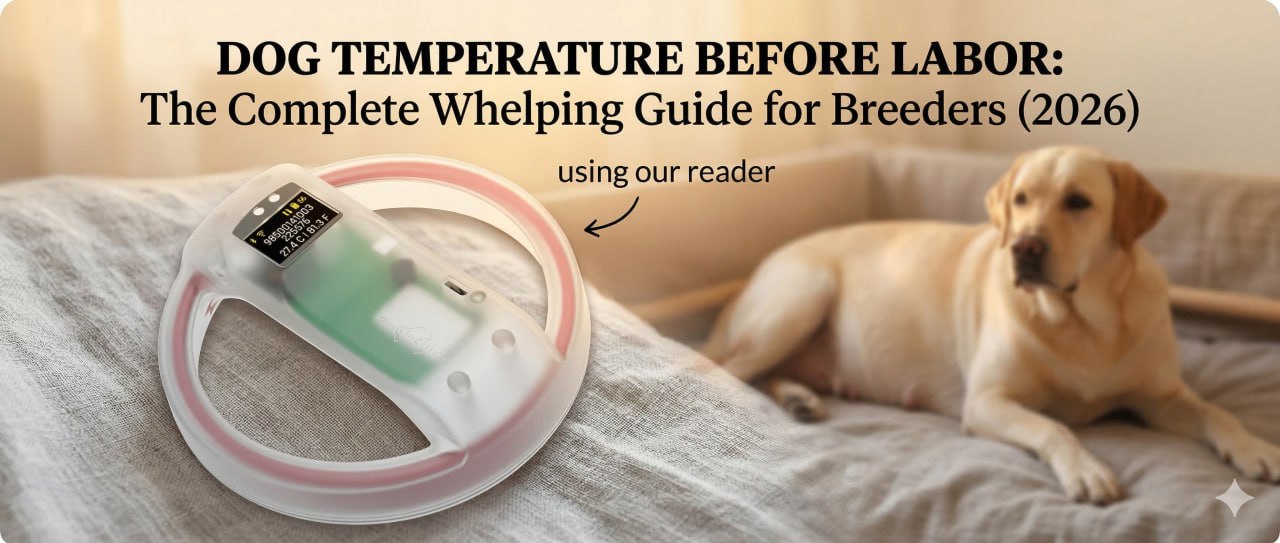
- No daily rectal checks required — the temperature biosensor microchip stores the dog's temperature, which you can read anytime with the A-Chip temperature microchip reader.
- Quick temperature checks — scan the microchip with the A-Chip reader to see the current temperature and detect when it drops before labor.
- Complete temperature history — readings can be saved to build a temperature chart over the last 30+ days.
- Efficient kennel monitoring — check multiple dogs quickly with one scanner instead of using separate thermometers.
- Lifetime identification — the biosensor chip also functions as a permanent ISO microchip for identification throughout the dog's life.
🌡️ Tired of 2 AM temperature checks?
The Animal ID temperature microchip makes monitoring easy — check your dog's temperature in seconds with the A-Chip reader, with no stress or constant handling.
View Breeder Products →Temperature Drop by Breed: Does It Vary?
Yes, slightly — but the mechanism is the same across all breeds. Larger breeds tend to run slightly lower baseline temperatures than smaller breeds.
- Labrador Retriever: Baseline 101.0–102.0°F, pre-labor drop to 98.5–99.5°F
- German Shepherd: Baseline 101.0–101.8°F, pre-labor drop to 98.0–99.2°F
- Golden Retriever: Baseline 101.2–102.2°F, pre-labor drop to 98.8–99.4°F
- French Bulldog: Baseline 101.5–102.5°F, pre-labor drop to 98.5–99.5°F
- Dachshund: Baseline 101.5–102.5°F, pre-labor drop to 98.5–99.5°F
The absolute threshold of "below 99°F" is a good rule of thumb, but your dam's personal baseline always matters more.
5 Mistakes Breeders Make With Temperature Monitoring
- Starting too late. Start at day 56, not day 61. Without a baseline, a single low reading means nothing.
- Inconsistent timing. Temperature fluctuates up to 1°F throughout the day. Same time, every time.
- Single-reading panic. One reading below 99°F isn't enough. Two consecutive readings confirm the drop.
- Relying only on temperature. Watch for nesting behavior, food refusal, restlessness, and visible contractions alongside the temperature data.
- Ignoring breed baseline. Know your dam's personal normal range. 99.8°F means different things for a Great Dane vs. a Chihuahua.
Pre-Whelping Checklist
When temperature drops below 99°F, run through this:
Environment:
- Whelping box clean, dry, set to 85–90°F
- Clean towels and gloves ready
- Vet's emergency number posted nearby
- Puppy scale ready for weighing each pup within 24 hours
Dam behavior to watch for:
- Refusing food (normal 12–24 hours before labor)
- Nesting — digging, rearranging bedding obsessively
- Shivering or trembling (from the temperature drop itself)
- Vaginal discharge (clear or slightly blood-tinged mucus is normal)
- Visible abdominal contractions
Frequently Asked Questions
Q: My dog's temperature dropped to 99.1°F but she's acting normally. Is this labor?
Possibly early pre-labor. Take another reading in 4 hours. If it drops further or holds below 99°F, labor is approaching. If it rises back above 100°F, it may have been a transient fluctuation.
Q: 24 hours have passed since the drop and still no puppies. Is something wrong?
Call your vet. This is unusual and warrants evaluation.
Q: Can I use a human thermometer?
Yes — a digital rectal thermometer works fine. Do not use glass thermometers (breakage risk) or ear/forehead thermometers (inaccurate for dogs).
Q: My dam is a French Bulldog scheduled for a C-section. Should I still monitor?
Yes. Temperature monitoring helps time the surgery correctly. Most vets prefer to operate after the temperature drop is confirmed — this ensures the puppies are mature enough for delivery.
Q: At what temperature should I call the vet?
Call immediately if temperature goes below 97°F or above 103°F.
The Bottom Line
A sustained drop below 99°F — held across two or more readings — means active labor within 24 hours. The rectal thermometer gets the job done. But temperature-sensing microchips take the stress out of the process: continuous monitoring, real-time phone alerts, zero handling of the dam, and permanent data you can review for every litter.
If you're managing more than one breeding female, or you're tired of 2 AM temperature checks, visit store.animal-id.net — or email us at vk@animal-id.net and we'll walk you through the right setup for your kennel.
```